Categories

Follow Us!

Check out our new lifestyle blog!

Subscribe!

Subscribe to my blog for updates


Previous Gina McMurtrey Interiors Blog Posts

Archive for the ‘Interior Design’ Category

Photo by Paul Hellstern via NewsOK

Almost 2 years ago to the day (May 22, 2011), our neighboring city Joplin, MO was hit by a massive tornado that was a wide and spread over a 6-mile stretch.  The third-deadliest twister to hit our country, America and the world responded with extraordinary kindness, donations and physical help as the town was nearly leveled.

Now, Moore, OK…a mere 5 hours to the West…has endured an unbelievable tragedy.  A massive tornado ripped through that Oklahoma City suburb, leveling the town and hitting an occupied elementary school.  Casualties are mounting and the scope of the devastation is on track to surpass Joplin’s.  Many of us affected by Joplin’s experience have watched the news with trembling and sorrowful hearts.  It’s time to give back just as many, many gave to our neighbors during their time of need.

Events like this are overwhelming.  What can one person do?  What can you do if you live far away and cannot physically assist in the recovery and rebuilding efforts?  What we all can do is team together in donating to these organizations.

Right now, these relief teams are being deployed to Moore to bring in needed health and food supplies, blood and medical units, and assistance for shelter.  Do your part in person or with financial assistance. Remember that rebuilding and family needs will extend for months, so check back with these organization to see updated lists of supplies or needs.

Thank you for making a difference!

A leader in world assistance for food and water distribution, Springfield-based Convoy of Hope is already on the scene.  Text CONVOY to 50555 to donate $10 to rescue/aid work in Moore. Check out Convoy of Hope for more details.


The American Red Cross also has information regarding shelters, and can take donations online for essential items that these victims will need as the relief and rebuilding effort continues.

Share
May 21, 2013 2:32 am

How awesome is this!?

In the May 2013 “House Beautiful”, above a photo of a carved wooden monkey, interior designers Jeffry Weisman & Andrew Fisher shared this secret entrance to their design studio.

I think it’s magical! It’s such a simple execution with a brilliant result.

I want one.

Here are some other ways to incorporate a secret passage in your home:


Floor spiral staircase wine cellar by Spiral Cellars
Exterior hidden garage door in San Francisco, by Beausoleil Architects
Share
April 26, 2013 8:38 pm

Bedding image: The Finley Collection by Sferra

Sheeting is the little black dress of the bed.  It’s the base of the “look” and it must feel good and compliment the wearer.

Believe it or not, we’re all a bit like the princess in the fable “The Princess and the Pea.” Our skin is pretty amazing at detecting qualities in fabric that are too small to see with the naked eye.  That is precisely why one set of cotton sheets can feel rough and the other as smooth as silk.

Once you make the shift to a higher quality sheeting, you will never view sleeping the same.  I’ll never forget  the day I replaced our cheap sheets to luxury sheeting.  I’m pretty sure my husband and I made “sheet angels”—you know, like the ones you make in the snow, but this time it was with sheeting.  Now that we are completely spoiled, our sheeting purchases will be based on something entirely different than price (although that still makes a bit of a difference.)

When purchasing sheeting, there are a two main things to take into consideration: construction of the fabric (percale vs. sateen and thread count) and fibers used.


PERCALE vs. SATEEN

All sheeting is woven.  The texture, or hand, of the fabric created is determined by how it is woven.  Woven fabrics have two directions that the fibers run: horizontal (or the warp) and vertical (the weft.)  Remember the old fashioned pictures of Native American women weaving blankets?  The yarns that are strung on the machine going up & down are the warp.  She then takes a shuttle with other yarn attached and weaves it side-to-side through the warp yarns.  The shuttle yarns make up the weft.  If a fabric has a pattern woven into it, it is typically due to the weft fibers and how they are woven through the warp.


Percale sheeting

Classic Percale by SDH

Percale sheeting is woven in a simple basket-weave—over one and under one.  This creates a strong fabric with a somewhat crisp hand.  Percale sheeting breathes well and is usually inexpensive to produce, but tends to wrinkle.

percale sheeting weave pattern close-up

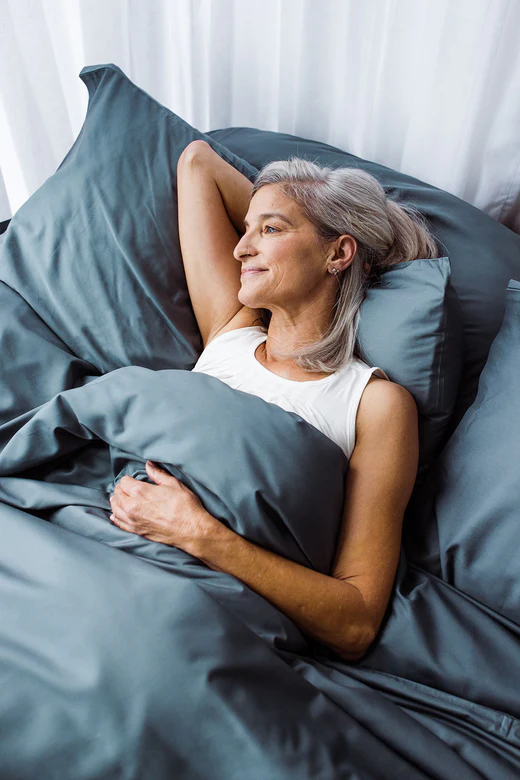
Percale sheeting is well suited for bedding that will get a lot of use, such as in hotels, time-shares and Bed & Breakfasts.  Also, women who suffer from night-sweats would benefit from the cool nature of percale sheeting.


Sonata sateen sheeting by SDH

Sonata Sateen Sheeting by SDH


Sateen sheeting is woven where the weft fibers may cross over the top of several warp fabrics before going under.  This pattern is offset in each row in order to offer fabric strength.   Sateen fabrics have a more smooth, slightly shimmery, silky hand than percale as the skin delicately perceives the interruption of fiber direction, even on that minute level.  Preferably, sateen sheets should be ironed after laundering to retain that lustrous look.

Sateen sheeting weave pattern close-up


Sateen sheeting is perfect for the person who wants the luxury of satin sheets without the slippery feel.  It is also a good alternative to flannel in cooler climates and offers a very luxurious sleeping environment.


THREAD COUNT

Thread count is an area that is widely misunderstood.  How is it that you can find a 500 thread count Egyptian Cotton sheet set in a kiosk at the mall for $59, yet find another set of luxury brand 500 thread count Egyptian Cotton sheeting for $400?

There is little regulation on how a company determines “threads per inch” or thread count.  What differentiates high-quality and inexpensive sheeting is the individual threads, or yarns, that are used to make the weave.  This inconsistency usually occurs with natural fiber sheeting.

To attain a high thread count, the weave must be tight.  Simple enough.  However, a lower-end manufacturer may use short-staple cotton, or shorter yarns that are twisted together to produce a longer yarn, or a “ply yarn”.  Some manufacturers will consider the ply yarn as two yarns, which is a misrepresentation.  Higher quality manufacturers will only count the single ply count or longer fibers in their thread count, giving a truer representation of the character of the fabric.  Fine sateens will have less raveling, a higher density, feel smoother to the touch, and have a  longer lifespan than budget, multi-ply thread count sheeting.

Clearly, the thread-count issue is confusing.  Researching your sheeting brands before purchasing is a good way to understand how they produce their material and if you’re getting a quality product.


SHEETING MATERIALS FOR THE LUXURY BED

Legends® 600-Thread Count Egyptian Cotton Sheeting by The Company Store

Cotton is the most widely used sheeting material.  It’s relatively inexpensive, breathes well and feels great.  In budget sheeting, cotton is often combined with polyester to reduce wrinkling and lengthen the lifespan, but quality sheeting will be made from 100% natural fibers.  The different cotton varieties used can change both the quality and price of your sheeting.

The best kind of cotton to be used for sheeting is “long staple”…meaning that the plant produces long fibers (staples), enabling a smoother, stronger yarn.

Egyptian cotton is considered the best cotton in the world.  It produces the longest, smoothest, softest staple and is used in the best sheeting available.

Pima cotton is produced in Western part the United States, Peru and Australia.  It offers a long, silky staple and is a fine, cost efficient cotton option.

Organic cotton is cotton that is produced without the use of pesticides.  Often, organic cotton sheets are also dyed with natural dyes to have the least invasive production possible. This is a great option for eco-conscious consumers.

Cotton can be woven in both percale or sateen, and in a variety of patterns called brocades.


Modal, Bamboo or Lyocell sheeting is created using pressed wood pulp.  This wood pulp is pressed through a “strainer” to create long, super silky strands of yarn.  Bamboo and Beechwood offer antimicrobial and hypoallergenic properties. These sheets are amazingly soft and have a subtle sheen.  Many of these wood-fiber sheets are woven in the sateen weave, but a few offer percale.

My first experience with modal sheeting is unforgettable.  I was dressing out a client’s bed and she chose SDH’s “Classic” by Legna.  The hand was unbelievable.  If water could be a fabric, it would have been these sheets.  Extremely high end, I’ve never felt anything like them.


Linen is one of the oldest fabrics used in the world.  Lightweight and strong, linen sheeting is a sign of affluence and fine living.  They get softer the more they are laundered and is an excellent choice for hot climate.  Linen does wrinkle, so there is more maintenance required.


Silk is another high end sheeting material, naturally hypoallergenic.  These silky, soft sheets are more dense than others, so they’re more suitable for cool climates.


The take-away…purchase the highest quality sheets you can afford.  Try a set of pillowcases first for a test-drive at an affordable price, and I’m sure you’ll agree that the differences in your sleep experience are worth the cost.

Next time, we’ll explore the top of the bed—the accessories, options in design, and trends in boudoir décor.


Need help designing your dream bedroom?

Contact us today to schedule an in-home consultation!

THE GUIDE TO THE WELL-DRESSED BED: The basics of a well-dressed bed

 •

THE GUIDE TO THE WELL-DRESSED BED: The Foundations—Featherbeds, down comforters and oh so many pillow choices…

 •

THE GUIDE TO THE WELL-DRESSED BED: Bedding design—From simple to elegant, the décor of the boudoir

Share
April 12, 2013 3:35 pm